Tuesday, 22 January 2013

TESSSSSSSSSELATION

TESS TESS TESSELLATION. 

WELL, basically the big word '' TESSELLATION' is the process of creating a two-dimensional plane using the repetition of a geometric shape with no overlaps and no gaps. Generalisations to higher dimensions are also possible. Tessellations frequently appeared in the art of MC ESHER, who was inspired by studying the Moorish use of symmetry in the Alhambra tiles during a visit in 1922. Tessellations are seen throughout art history, from ancient architecture to modern art. 


Where as we are asked to include Gestalt principles inside which are : 

SIMILARITY 
PROXIMITY
CLOSURE
FIGURE AND GROUND 
ALIGNMENT 
CONTINUITY 


Gestalt is a psychology term which means "unified whole". It refers to theories of visual perception developed by German psychologists in the 1920s. These theories attempt to describe how people tend to organise visual elements into groups or unified wholes when certain principles are applied. 

All i can say is, Tessellation consist of  PATTERNS. PATTERNS ARE MY THING. I am in love with patterns. Everywhere i go, i see patterns. People even have their own significant pattern ( personality and characteristics ) How about clothing? Clothing have their own specific pattern as well. And a lot more VARITIES of PATTERNS we can see around us. A simple pattern can be fit perfectly together like 'doin the math' that it doesn't make it JUST a pattern anymore, in fact this takes patterns and math to a whole new level , anywhere you go and anywhere you stand, you'll definitely see patterns. There are too many different kinds of TESSELLATION. 

Let me show you examples of TESSELLATION . 


For this project, Mr Charles have given us to explore and incorporate GESTALT PRINCIPLES ( as i mentioned it above) in our TESSELLATION.  This project is quite challenging as there so many types of  techniques. Tessellations do not have GAPS, OVERLAPS and are SYMMETRICAL. Some have the sense of DYNAMIC/STATIC principles.  


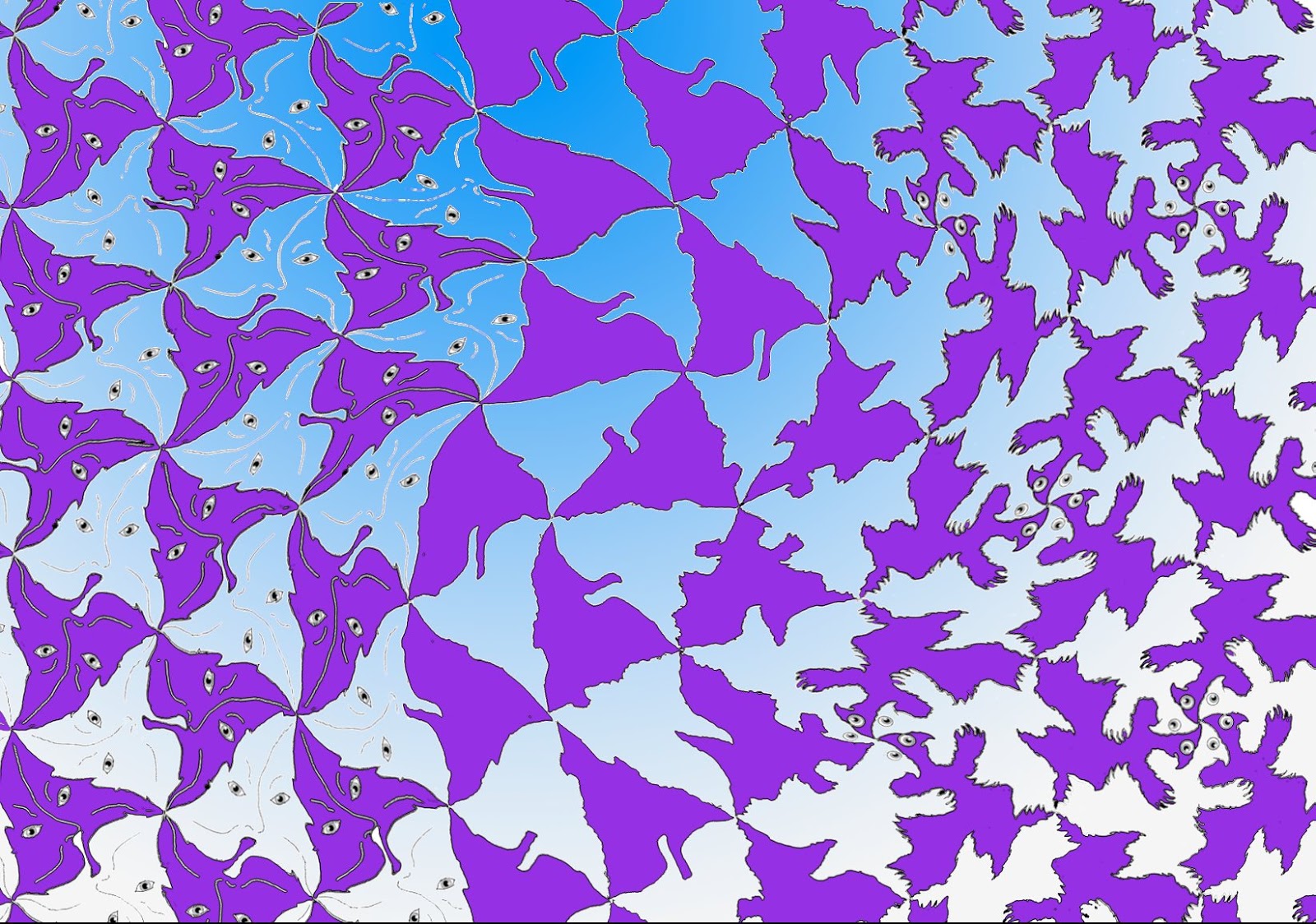
Sooo, here are my own version of TESSELLATIONS that includes Gestalt principles. 

FIGURE & GROUND
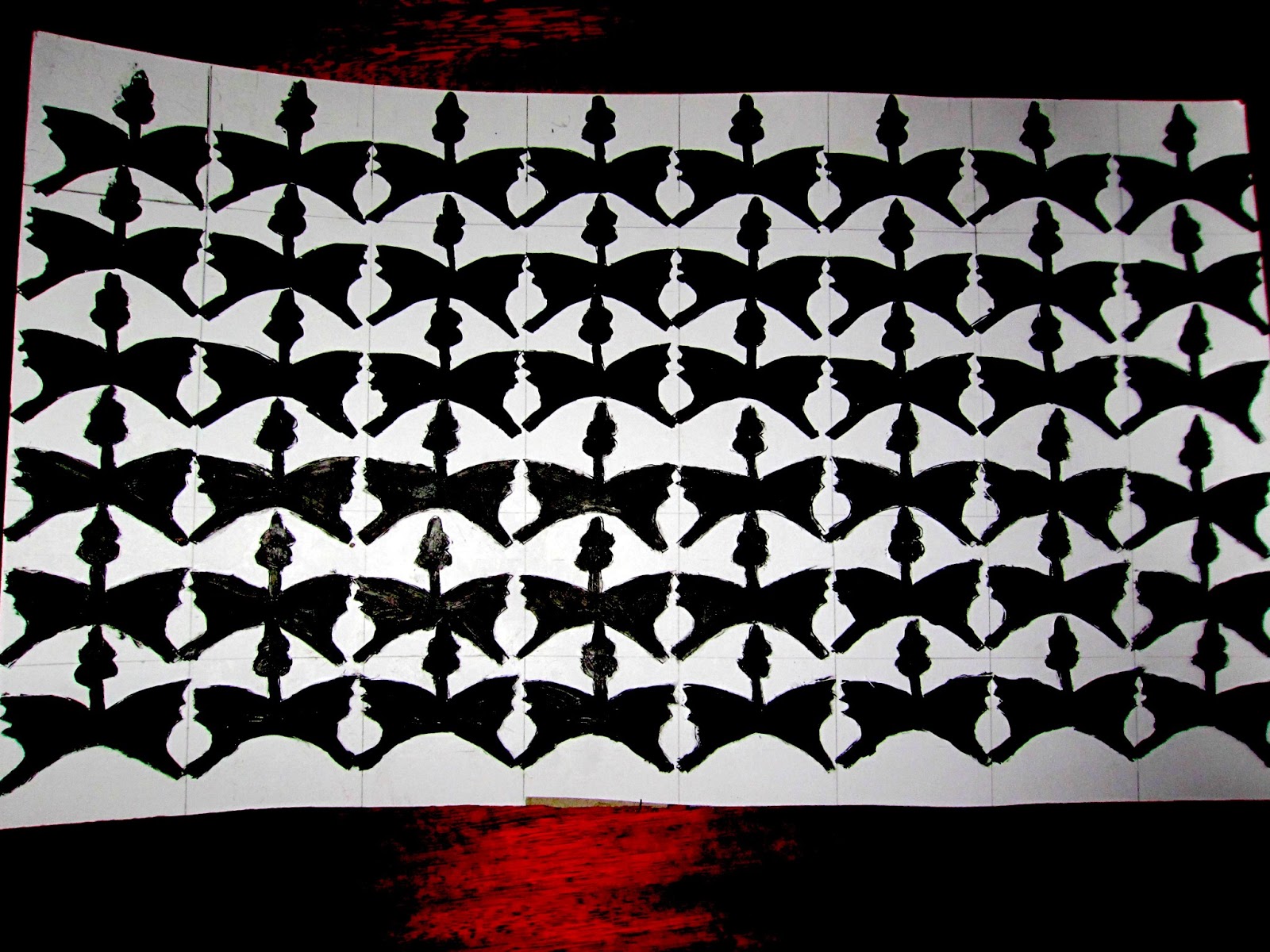


PROXIMITY 


'' Look into it for few seconds, can u see an illusion''?? 


SIMILARITY 


( Elevator )


CLOSURE


''WOLVES'' 


CONTINUITY 


The continuation from left to right. 

ALIGNMENT 


Conclusion, it has been  a really tough project yet challenging too. But it was interesting and i could play around with so many patterns and colours. In Latin, tessella is a small cubical piece of clay, stone or glass. The word "tessella" means "small square" . It corresponds with the everyday term tiling which refers to applications of tessellations, often made of  glazed clay.

Anyways, signing OFF! xoxo


Monday, 21 January 2013

CUT CUT , PAPER CUT ;

HELLO ONCE AGAIN!   Yup another blog post about PAPER CUT. Mr Charles insist on giving us  this assignment to understand the concept behind it. This is another task that we have to do is to make pieces of paper cut designs and artworks to paste it on the mounting board . I have chose and designed my own personal PAPER CUTS to represent each and every principle. You can see the forms, shapes and all kinds of designs that i will show you throughout this post. 


First up, ASYMMETRICAL BALANCE :


placement of non-identical forms to either side of a balancing point in such a way that the two sides seem to be of the same visual weight..


SYMMETRICAL BALANCE ;


 Symmetrical balance is mirror image balance. If you draw a line down the centre of the page, all the objects on one side of the screen are mirrored on the other side (they may not be identical objects, but they are similar in terms of numbers of objects, colours and other elements. Sometimes they are completely identical (often seen in architecture).


theme : Squirrels 


REPETITION AND RHYTHM :


Rhythm in design is also called repetition . Rhythm allows your designs to develop an internal consistency that makes it easier for people to understand. Once the brain recognises the pattern in the rhythm it can relax and understand the whole design. Repetition rarely occurs on its own and so it imbues a sense of order onto the design. And because of this, repetition attracts attention and prompts people to investigate further.


UNITY AND VARIETY :


Unity is the feeling that everything fits together.  It is a feeling of oneness.  The opposite of unity is disunity, a feeling of disorder.  In art, unity is often achieved by the repetition of a shape, a color or another visual element.  Another method is simplicity.  Simplicity is the use of one major color, kind of shape or element to unify a work.


Variety is often said to be the spice of life.”  In art, variety is like a spice.  A totally unified work is likely to be boring if it has no variety.  Variety is the use of contrasting elements to make something interesting.   The contrast, or difference, may be subtle, such as a slight change in texture or color within an area.  It may be more obvious, such as a sharp difference in the materials, sizes of shapes, color or lighting.  Just as we appreciate unity and variety in nature, we seem to want unity and variety in our lives - and in our art.


DYNAMIC ;


Dynamic composition on the other hand, uses many diagonal lines. Diagonals are somewhat unsettling, which results in a sense of movement, energy, excitement that generates from a dynamic composition. 


STATIC ;


Lacking in movement, action, or change, esp. in a way viewed as undesirable or uninteresting.


DOMINANCE ;


Dominance is about the focus given to a part of a work of art. It also helps to create unity as the eye is attracted to a key point then led around the image by pictorial elements. Dominance can be created by contrasting pictorial elements such as line, shape, tone, texture, direction, size or color.


SCALE AND PROPORTION ;


Scale refers to overall size and proportion refers to relative size. Scale and proportion principles help the viewer organize an image and they can be used to create or minimize points of emphasis. If an object is out-of-scale or oddly proportioned, then it will create a point of emphasis. Also, large scale objects create obvious visual weight. We automatically perceive larger objects as closer and more important than smaller objects.
Proportion also pertains to the design of objects and their placement in the frame. For example, having the focal point dead-center is usually not very interesting, it is usually better placed along one of the “thirds”. The ancient Greeks studied mathematics and that it was the controlling force of the universe.


THATS ALL FOR NOW ;D It was one hectic and tiring project but I HAD FUN! :)


Monday, 12 November 2012

*UNMASKING VINCENT*


hello again! ;D 

Now now, lets move on to another topic that i want to tell you guys about. 
.
.
.
.
.
.

M.A.S.K.


From what i have research, mask is an object normally worn on the face typically for protection,disguise, performance or entertainment. Masks have been used since antiquity for both ceremonial and practical purposes. They are usually worn on the face, although they may also be positioned for effect elsewhere on the wearer's body.


One thing i like about MASK, is that you can wear it in any cultural occasion or even an event. Mask in my terms, is known as an expression or anonymous identity without showing our real identity to the world. It is so special in a way that , even though you 're not showing your real identity , but you give out curiosity to others of knowing who you are. 

In the history , The use of masks in rituals or ceremonies is a very ancient human practice across the world, although masks can also be worn for protection, in hunting, in sports, in feasts or in wars, or simply used as ornamentation.Some ceremonial or decorative masks were not designed to be worn. Although the religious use of masks has waned, masks are used sometimes in drama therapy or psychotherapy.


There are many different types of mask in this world. And what i

 mean by ''differences'' is differences 

in cultural base. You can from below that each mask is special in a 

way and how it was made, and the 

designs of each different country. The masks represents their own 

religion and culture through looking 


at their function as well.


BEIJING , CHINA 


EUROPE PARADE


KOREAN MASK


MIDDLE EAST GOLDEN MASK


OLDEST MASK IN THE WORLD : STONE MASK


THEATRICAL MASK


INDIAN MASK


VENETIAN MASK


MASQUERADE MASK


JAPANESE MASK


My personal favorite. I love japanese culture because of their 

designs of masks, clothing, hairdo, make up and etc. 

  
How they present themselves, really attracts my attention.


HALLOWEEN MASK

; purposes for halloween party/event


ALASKAN NATIVE CULTURE MASK


JADE MASK


AFRICAN MASK


 NORWEGIAN MASK


BALINESE MASK


OTHER TYPES OF MASK


So, what i have shown you are some varieties of mask base on culture or events. 

Now what i am about to show you is our types of masks base on our group project. For some of you who does not know what is '' faceless'' mask, I'm about to show you and tell you what is ''faceless'' mask all about.


In this project in contextual studies, Mr charles have asked us to divide ourselves in groups. We were asked to produced a short film video about our title '' UNMASKING VINCENT''. Yes, the name '' vincent'' is our main actor of the video.  

What i am trying to say is, in reality, people wear mask, everyday, everywhere, whenever, and anywhere we go.
We wear mask for a reason. And that reason is to not only cover our appearances but  covering our true self or feelings. Sometimes when we put on each and every expression,without realizing it, we might be wearing a mask. 

This because we do not dare to face the world. We do not dare to let others see what we are inside that mask. 


Thing is, what is beneath that mask? Is it a happy person, a sad person, a worried person, an angry person, a frustrated person or etc? We do not know. The only thing to know who we really are, is to remove that mask. 


So, in this project, we are required a video to show our understanding about '' MASK''. 
How we decided to come up with our '' MASK'' video is base on bandages''.


*BANDAGE YOUR MASK*

Here is a sneak peak of our production '' UNMASKING VINCENT''.

* Thanks to Vanessa for snapping pictures *

We decided to shoot our video @ the ABANDON BUILDING 


ELEVATOR 


BASEMENT 


GETTING READY TO MASK '' VINCENT''


PAINTING TIME!!!

DURING OUR SHOOT :


VINCENT : RAWWWRRRRR


YUP, OUR MAIN ACTOR.


SHOOTING AT THE BASEMENT :


THAT IS ME :)


BOOOOO!!


 PHOTO SHOOT TIME :


 WALKING DOWN TO THE BASEMENT :


MUAHAHA : VINCENT & SUET YING.


JENG JENG JENG
 * OUR VIDEO IS OUT*


U.N.M.A.S.K.I.N.G VINCENT!